Operations AI
AI that reads your documents, reconciles your records, and answers from your data. It holds up in production because we build the context first: the definitions, codes, and exceptions specific to your business.
Pilots don’t fail on the model. They fail on context.
The model can already read an invoice. It doesn’t know that your vendor writes one product under two codes, that net sales means after returns, or which of three revenue columns is the one you report. That knowledge lives with your people, in no system a model can see.
So the demo impresses, and the first week of real work stalls it. The fix is not a better model. It is a place where your business’s knowledge is written down, checked, and kept current, so the AI can stand on it.
We build the context first.
Databases and spreadsheets, and the definitions that make the numbers mean something.
Contracts, invoices, records, and the procedures written around them.
Who checks what, what counts as done, and where the exceptions go.
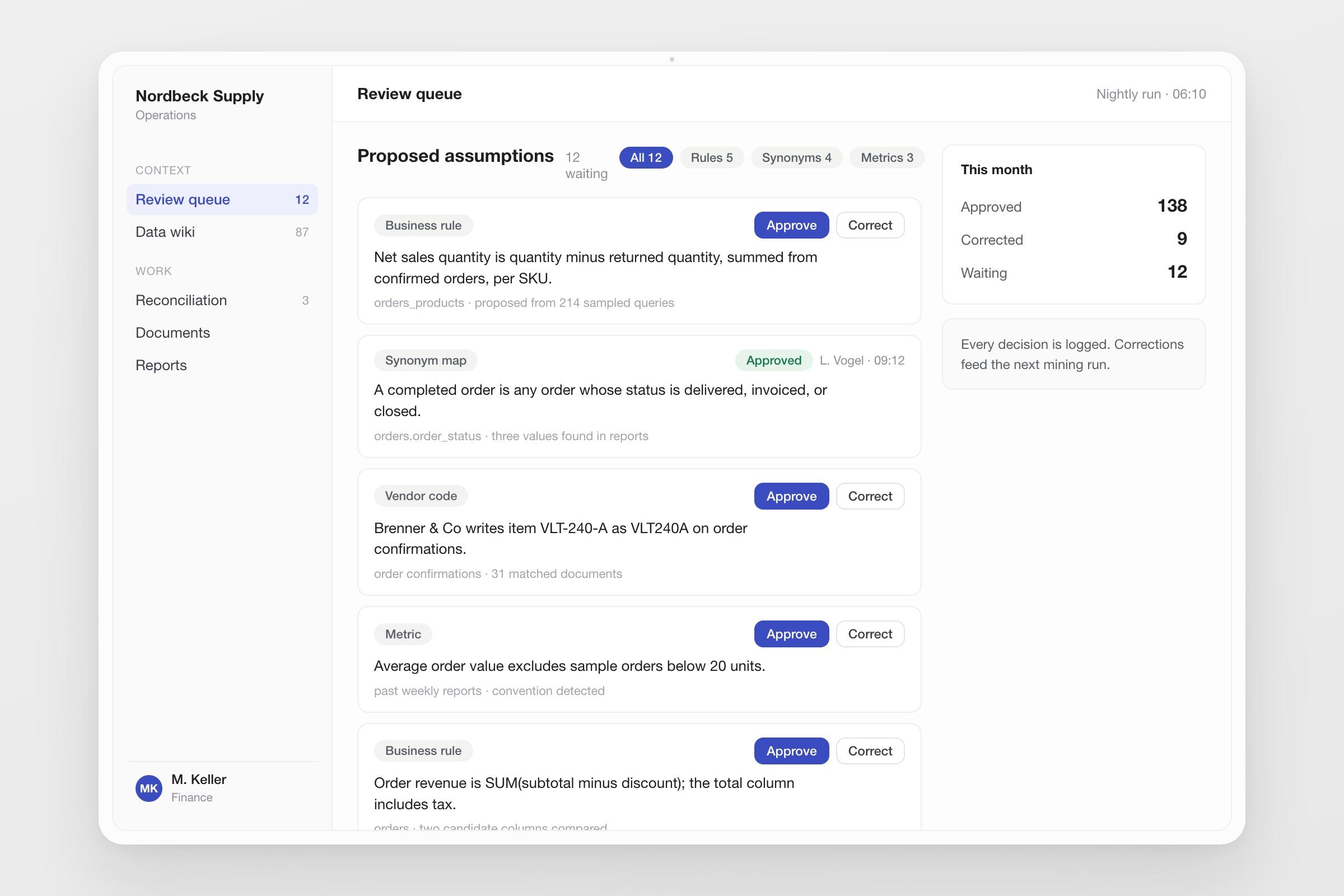
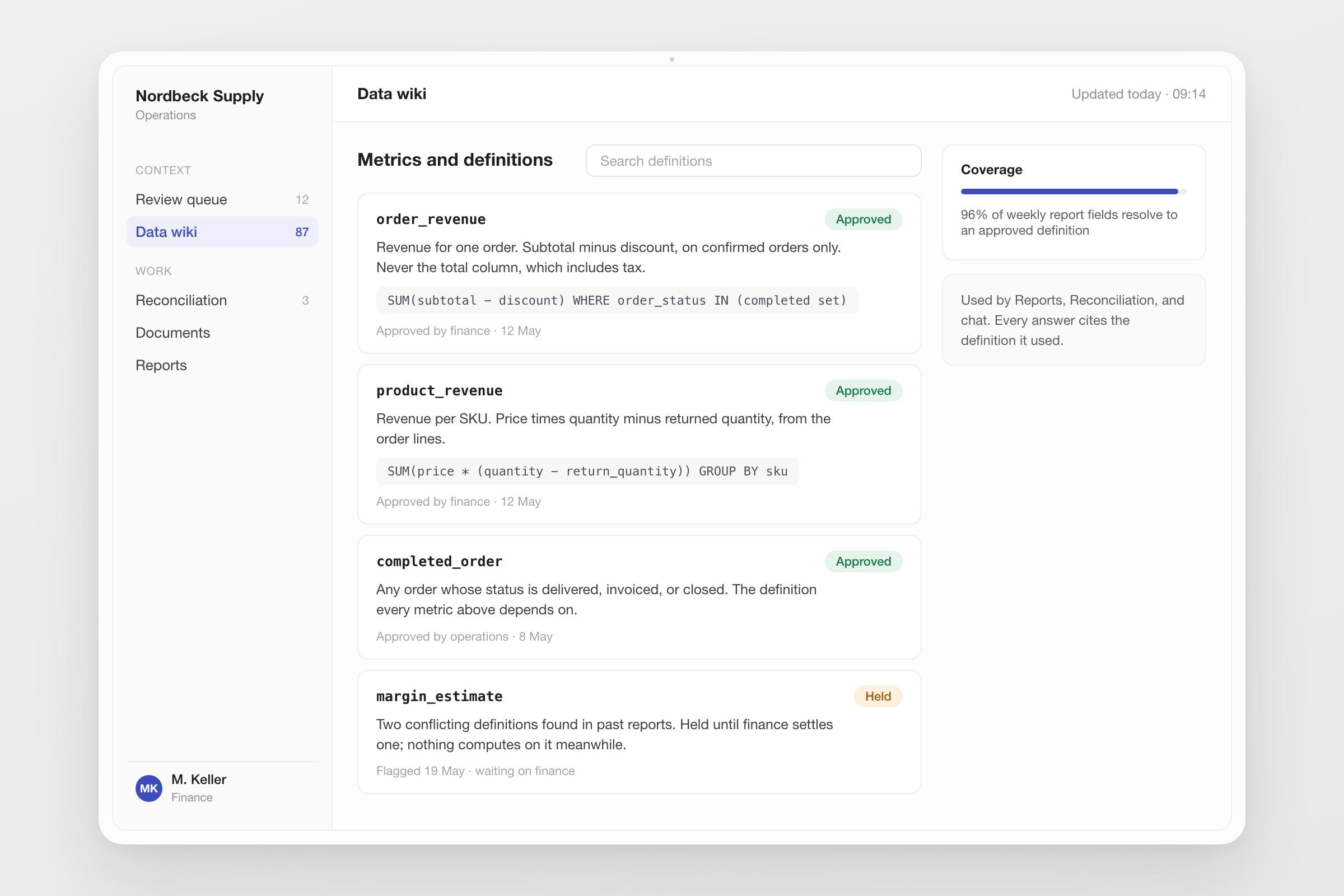
Context is not a prompt. The system proposes what it thinks is true about your business, one assumption at a time, and your team approves or corrects each one in a review queue. What’s approved collects into a data wiki your people can open and read: the ground the workflows run on, and the audit trail for every answer they give.
How we work.
We connect to your systems read-only and seed the layer with what already exists: schemas, past reports, procedures. Your team verifies what the system proposes.
On verified context we release workflows that do the job: reconciling, matching, reporting, answering with sources. Where a decision matters, a person signs it.
Every correction becomes context. New workflows start from everything already proved, so each release lands faster than the last.
What we deploy.
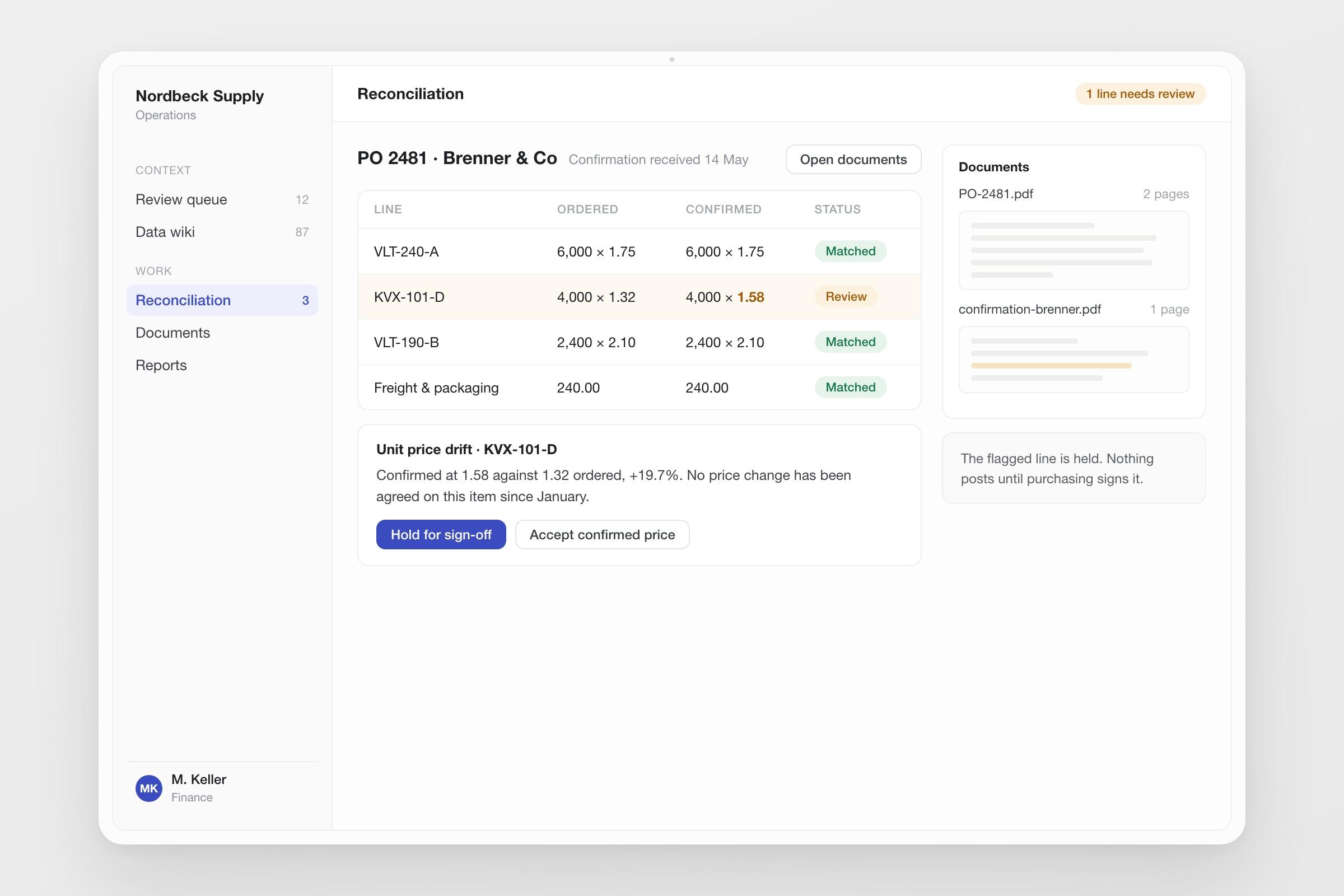
Order, confirmation, and invoice compared line by line. Mismatches flagged for sign-off.
The same product under different codes, matched across systems.
Answers from contracts and procedures, each one citing its source.
Paper and PDF read into structured records, checked before they land.
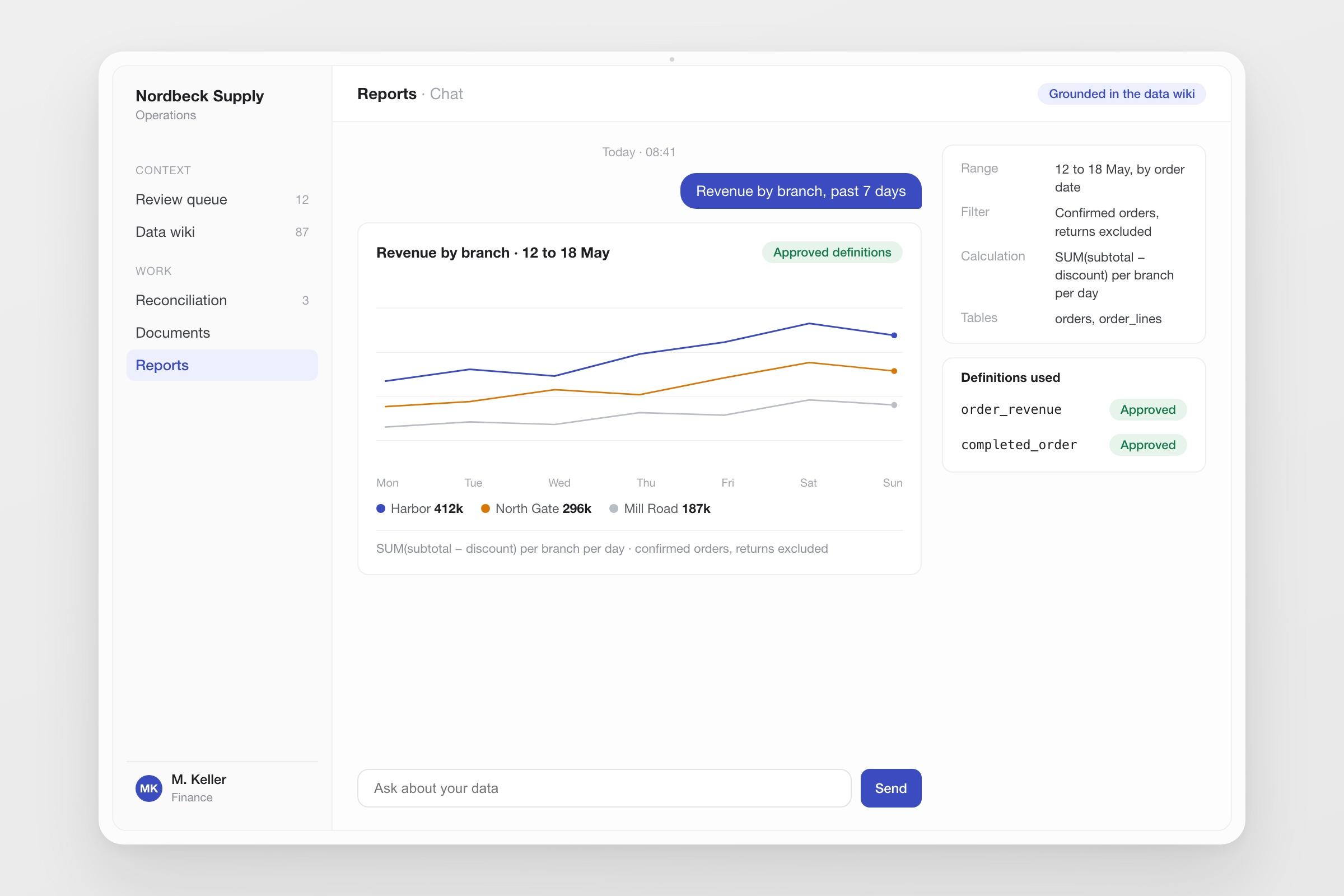
Ask in plain language. The answer shows the calculation behind it.
The weekly pack assembled from live data, on schedule.
Your metrics in one wiki, approved by your team, shared by every workflow.
Scripted steps where no model is needed, run in the same harness.
Nothing ships without a signature.
Assumptions are approved before AI acts on them, and decisions are logged, so every output can be traced.
Cloud, on-prem, or hybrid. Deployment follows data residency, existing systems, and IT policy.
Chosen per task across vendors. Switching one is a configuration change; the context stays.
The source, the data, and the context layer itself.
The first workflow is scoped small and goes live in weeks. By the time it runs, the context underneath it is built, and the second workflow starts from everything the first one proved.