Before AI was an industry, a product, or a trillion-dollar arms race, it was a summer proposal.
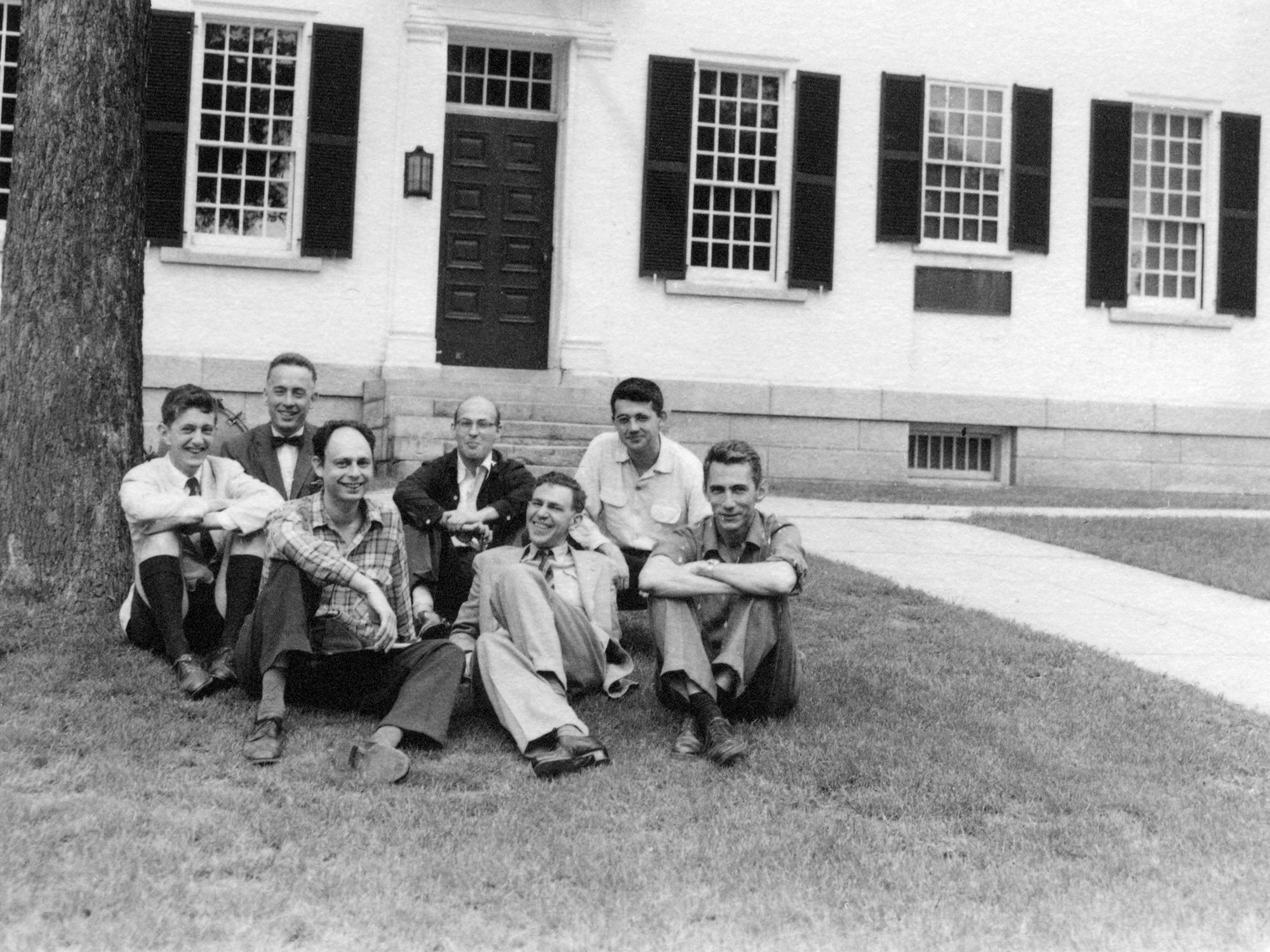
It's August 1955. A 28-year-old Dartmouth mathematician named John McCarthy helps draft a proposal for a two-month summer study. The budget is $13,500. The plan is simple: gather about ten researchers at Dartmouth College in the summer of 1956 and see whether intelligence can be described precisely enough for a machine to simulate it.
McCarthy recruits three co-authors: Marvin Minsky, Nathaniel Rochester, and Claude Shannon. Together, they produce one of the most influential research proposals in the history of computing — and in it they use the term artificial intelligence.
At the center of the proposal is a breathtaking claim:
"Every aspect of learning or any other feature of intelligence can in principle be so precisely described that a machine can be made to simulate it."
Then they outline seven problems they believe are worth attacking. They do not solve them that summer, and neither does anyone else. But those seven problems became a remarkably durable research agenda for modern AI.
Here they are. You'll recognize every one.
1. Automatic Computers
"The speeds and memory capacities of present computers may be insufficient to simulate many of the higher functions of the human brain, but the major obstacle is not lack of machine capacity, but our inability to write programs taking full advantage of what we have."
Look at how carefully they hedged this. Hardware "may be insufficient," they say, but the major obstacle is programming. Not the only obstacle. The major one. They wanted better ideas first, faster machines second, but they never pretended compute didn't matter.
Seventy years later, that balance still holds. The breakthroughs that changed AI (backpropagation, attention mechanisms, reinforcement learning) were algorithmic. But none of them mattered until hardware caught up: GPUs repurposed for matrix math, high-bandwidth memory, distributed training clusters. The bottleneck was never purely software or purely hardware. It was both, just as the proposal suggested.
2. Language
"It may be speculated that a large part of human thought consists of manipulating words according to rules of reasoning and rules of conjecture. From this point of view, forming a generalization consists of admitting a new word and some rules whereby sentences containing it imply and are implied by others."
"It may be speculated." They weren't even sure this was right. Maybe language is central to thought, maybe it isn't. But if it is, then reasoning might be modeled as operations on words and rules.
Seventy years later, this reads less like speculation and more like a design specification. Large language models are, in a literal sense, systems that manipulate tokens according to learned rules of reasoning and conjecture. GPT, Claude, Gemini are all built on the premise that language is central to intelligence, not peripheral to it. The authors couldn't have anticipated transformers or statistical learning. But they picked the right arena.
3. Neuron Nets
"How can a set of (hypothetical) neurons be arranged so as to form concepts. Considerable theoretical and experimental work has been done on this problem... Partial results have been obtained but the problem needs more theoretical work."
"Hypothetical" neurons. They weren't claiming to model biology. They just wanted to know: if you arrange simple neuron-like units in the right structure, can they learn to represent concepts?
The path from that question to modern deep learning was anything but straight. Neural-net research lost momentum for decades, partly from technical dead ends, partly from influential criticism (Minsky and Papert's 1969 Perceptrons among them). When neural approaches finally roared back, the conditions looked nothing like 1955: backpropagation trained at scale, GPUs repurposed for matrix math, massive datasets scraped from the internet. Today, neural networks with billions of parameters power vision, language, and decision-making worldwide. The question was the right one. The answer came from a direction no one expected.
4. The Size of a Calculation
"If we are given a well-defined problem (one for which it is possible to test mechanically whether or not a proposed answer is a valid answer) one way of solving it is to try all possible answers in order. This method is inefficient, and to exclude it one must have some criterion for efficiency of calculation."
They're describing brute force, and why it fails. A machine can try every possible answer. But if the number of possibilities is too large, that gets you nowhere. You need a way to be efficient.
This foreshadows complexity theory (P vs NP remains unsolved), but it also describes something more concrete. Training a frontier language model now costs hundreds of millions of dollars. Serving billions of queries demands its own breakthroughs: quantization, distillation, speculative decoding. The 1955 concern about "the size of a calculation" is now a line item on corporate balance sheets. The problem didn't go away. It got an engineering budget.
5. Self-Improvement
"Probably a truly intelligent machine will carry out activities which may best be described as self-improvement. Some schemes for doing this have been proposed and are worth further study."
In 1955, that sounded like science fiction. Now it sounds like a product feature.
AlphaGo Zero improved itself through millions of games of self-play, no human examples needed. RLHF lets language models refine their own outputs from human feedback. But these are tightly guided loops, not the open-ended self-modification the proposal imagined. We have systems that get better at defined tasks. Whether that's the same thing as "a truly intelligent machine carrying out self-improvement" is a question we still haven't settled.
6. Abstractions
"A number of types of 'abstraction' can be distinctly defined and several others less distinctly. A direct attempt to classify these and to describe machine methods of forming abstractions from sensory and other data would seem worthwhile."
This might be the deepest question in the whole document. How does a machine go from raw pixels, audio, or text to concepts? Not just recognizing patterns, but building reusable ideas that transfer across contexts.
Deep learning made surprising progress. A convolutional network learns to detect edges, then textures, then objects, all from data, never programmed by hand. Transformer models build representations of language that capture meaning, syntax, and reference at once. But the harder question is still open: can machines reason with abstractions the way we do, composing and combining them in genuinely novel situations? We've built powerful pattern-matchers. Whether they're genuine abstractors is something no one has fully answered.
7. Randomness and Creativity
"A fairly attractive and yet clearly incomplete conjecture is that the difference between creative thinking and unimaginative competent thinking lies in the injection of some randomness. The randomness must be guided by intuition to be efficient."
They call their own idea "clearly incomplete," and then describe something remarkably close to how generative AI actually works. Creativity requires randomness, they say, but randomness alone is just noise. It has to be guided.
If you've ever adjusted the "temperature" slider on a language model, you've touched this exact tradeoff. Diffusion models do the same thing with images: add noise, then carefully remove it. The design problem hasn't changed since 1955. Balance predictability against surprise. Competence against creativity. The conjecture was incomplete, as the authors said. But the direction was right.
Why This Still Matters
What's strange is how recognizable these problems still are. Language, neuron nets, randomness as creativity — these became central to modern AI, even though the methods that succeeded look nothing like what the authors imagined. Self-improvement and abstractions are still open in their full generality. "The size of a calculation" became a trillion-dollar infrastructure problem no one in 1955 could have foreseen.
The proposal couldn't anticipate GPUs, or the internet, or training runs that cost hundreds of millions of dollars. But it got the questions right. And those questions turned out to be more durable than any of the early answers.
AI feels new because the products are new, the money is new, and the scale is new. But many of the questions we're asking were first written down for a summer project in 1956. The answers came from directions the original authors never foresaw.
Cover photo: At the 1956 Dartmouth AI workshop, the organizers and a few other participants gathered in front of Dartmouth Hall. Photo: The Minsky Family, via IEEE Spectrum, "The Meeting of the Minds That Launched AI" by Grace Solomonoff.