Every night, as we sleep, our brains sort through the noise — filing away what matters, letting go of what doesn't. We dream, we drift, and behind the scenes, our memories are consolidated. AI agents — those increasingly present digital minds we interact with — are beginning to do the same. While they don't "dream" in the human sense, they go through structured routines to decide what to remember, what to prioritize, and what to forget. This process, as outlined in AI Agents: Evolution, Architecture, and Real-World Applications by Naveen Krishnan, is called periodic consolidation — and it's reshaping how AI stays sharp.

Why AI Needs Sleep Cycles
If AI agents constantly absorb new data without pause, they become bloated — slow to retrieve useful insights and prone to making irrelevant associations. Just like humans need rest to make sense of their experiences, AI agents need structured cycles to manage memory.
According to Krishnan's 2025 paper, these "sleep-like" phases aren't downtime — they're essential recalibration periods. During these phases, the agent doesn't simply store everything — it evaluates. Was this fact accessed recently? Does it connect to a recurring task? Is it useful in multiple contexts? Only the most relevant data stays. The rest gets reorganized — or discarded.
The Three Steps of Digital Memory
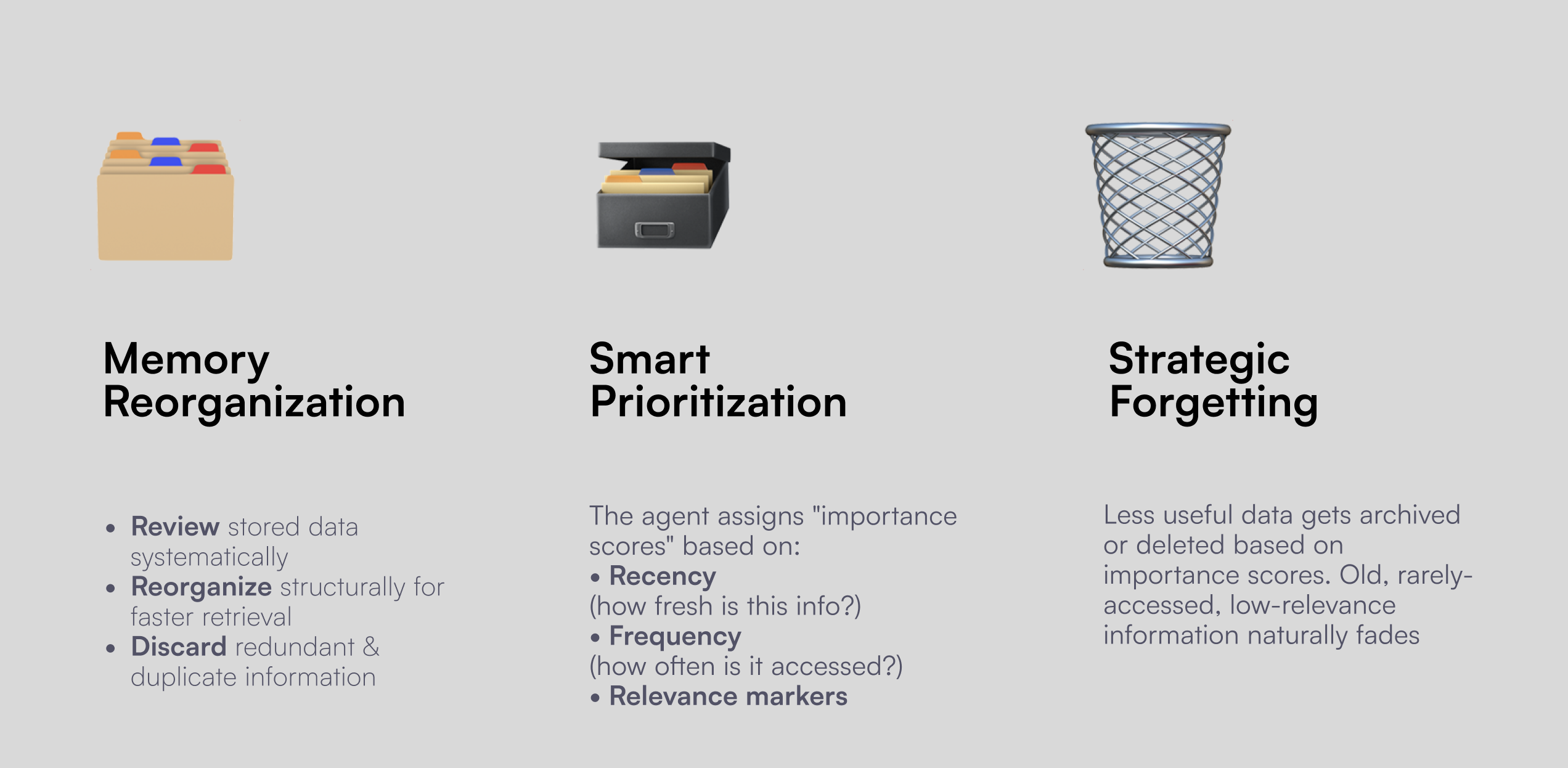
Here's how it works. First, the agent reorganizes its stored data — like tidying up a messy desk, grouping related pieces together for easy access. Next comes smart prioritization, where each memory is scored based on recency, frequency of use, and relevance. Finally, the agent engages in strategic forgetting, quietly phasing out old or low-value information to avoid clutter.
These aren't metaphorical behaviors — they're technical implementations drawn directly from memory system design. Krishnan likens this to the brain's hippocampus triaging sensory input: the AI agent doesn't just store — it curates.
Memory Isn't Just Storage
The misconception that memory equals storage misses the point. What makes AI intelligent isn't how much it can store — it's how well it recalls what matters, when it matters.
Krishnan's paper emphasizes this shift: instead of acting as an all-knowing database, the AI agent becomes a context-aware partner — one that forgets tactically and recalls strategically. Just as we forget a grocery list after the shopping trip is done, AI agents purge irrelevant logs after task completion.
This dynamic, cyclical memory model is what enables longevity, efficiency, and personalized interaction in real-world applications.
What This Means for the Future
The future of AI isn't just about generating answers — it's about building systems that adapt over time, much like we do. With memory cycles modeled on cognitive science, AI agents are moving toward long-term companionship: capable of learning from past interactions, updating themselves without intervention, and becoming more relevant the longer they engage with us.
As Krishnan writes, "Agents that manage memory effectively become more than tools — they become collaborators." In a world increasingly filled with AI interfaces, it's not their intelligence that will define their usefulness — it's their ability to forget wisely.